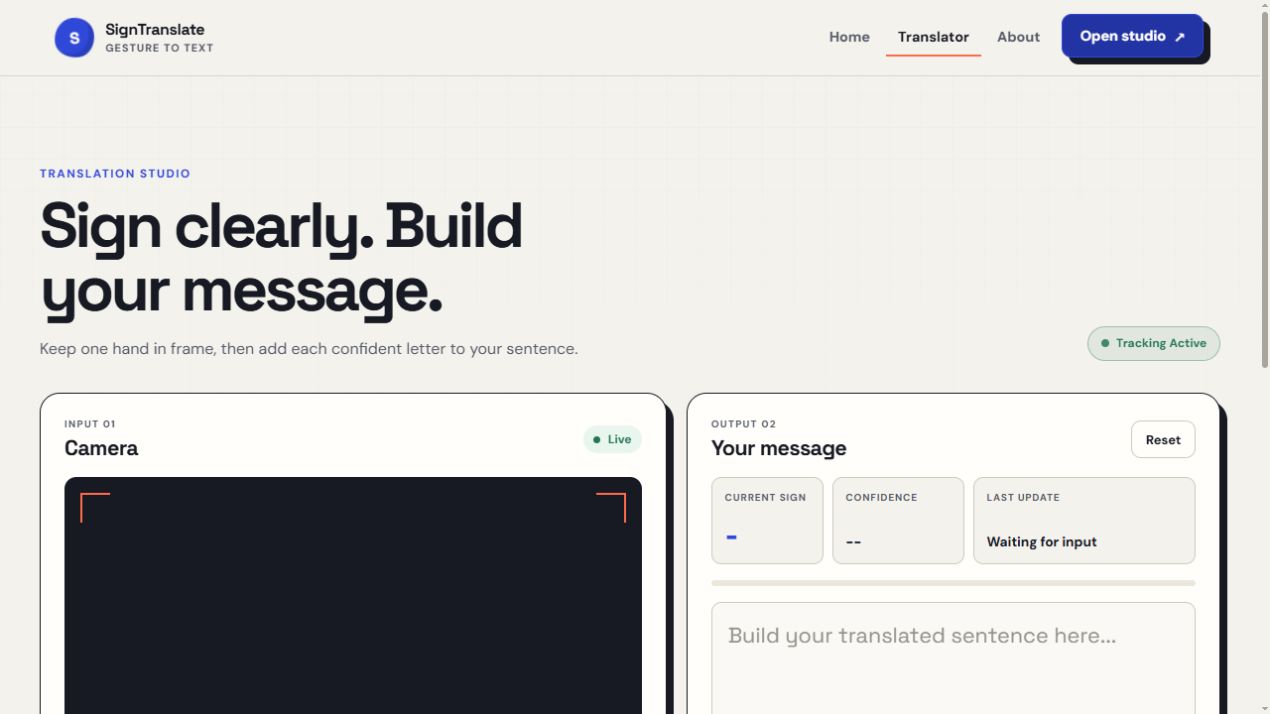
Real-Time Sign Language Translator
Live demoA React webcam interface and Flask inference API that turn MediaPipe hand landmarks into confidence-scored ASL alphabet predictions.

The problem
A live alphabet recognizer has to connect camera tracking, model input, inference, and readable feedback. I built this project to take a TensorFlow classifier beyond a training script and make its predictions usable in a browser.
What I built
- The camera and translation interface. React displays the webcam feed and tracked hand landmarks, sends prediction requests, and presents the returned letter and confidence in a translation console.
- A landmark-based training pipeline. MediaPipe supplies 21 hand points, each with x, y, and z coordinates. Those 63 features form the input to the TensorFlow classifier and its converted TensorFlow Lite model.
- A focused inference API. Flask serves the lightweight model and returns a prediction with its confidence score. Training and conversion remain separate from the deployed inference runtime.
Why I built it this way
- Use hand geometry as the model input. Landmarks give the browser and API an explicit feature contract: 21 points become one 63-value vector per prediction.
- Keep inference separate from training. A converted TensorFlow Lite model serves predictions while the extraction and training scripts remain available for improving the dataset and classifier.
- Show confidence and withhold weak predictions. The interface gates low-confidence results rather than always displaying a letter. Similar hand shapes still need better data and temporal modeling.
What I learned
I practiced the complete ML application path: extracting features, training and converting a model, serving inference, and connecting it to a live interface. Consistent input features and clear feedback matter as much as a working prediction endpoint.
Evidence & current limits
The demo and source are public. The current classifier uses one hand and one frame at a time; motion-based J and Z are unsupported. Similar letters, unfamiliar hand positions, and lighting can reduce accuracy. The project demonstrates alphabet recognition rather than full conversational translation.
More project screens
Explore the interface. Select an image to view it at full size.